
Lead aprons are one of the most common — and most trusted — pieces of personal protective equipment in any facility that works with ionizing radiation. Radiology departments, cath labs, dental offices, and veterinary clinics all lean on them every day to shield staff from scatter radiation. But a lead apron is only protective if it’s actually intact. Over time, folding, dropping, and general wear can crack the lead-equivalent shielding material inside, creating gaps that are invisible to the naked eye but very real to an x-ray beam.
That’s why routine inspection isn’t just good practice — for many healthcare organizations, it’s a compliance requirement. Below is an overview of how to build a solid lead apron inspection and inventory program.
Why Inspection Matters
A cracked or degraded radiation protection lead apron can quietly lose its shielding effectiveness in the exact spots meant to protect the most radiosensitive organs — the thyroid, chest, and pelvic area. Because damage often develops on the inside of the apron or along stress points like seams and fold lines, it’s easy to miss without a deliberate inspection process. Regular screening catches this degradation before it becomes a real dose risk to staff.
Who’s Responsible
Inspection and inventory responsibilities typically fall to the radiation safety or health physics program within a hospital system, working alongside the departments that use the zero lead aprons day to day. Institutional standards bodies, including the Joint Commission, generally expect annual inspection of medical equipment — lead aprons included — as part of a broader equipment safety program.
The Two-Step Inspection Approach
1. Visual and Tactile Inspection (Annual, Minimum)
Every apron should get a hands-on check at least once a year:
- Look for visible wear, cracking of the outer material, or discoloration.
- Feel along the entire apron — front, back, and seams — for sagging, lumps, or deformities in the shielding material, which often signal that the lead-equivalent layer has shifted or cracked internally.
This step is quick, requires no special equipment, and should be built into a routine maintenance schedule.
2. Imaging-Based Screening (When Condition Is in Question)
If a visual or tactile check turns up something questionable — or if an apron is simply due for a more rigorous check — fluoroscopy or radiography can be used to directly image the shielding material for holes and cracks.
A few important technical notes if your facility images aprons this way:
- Use manual technique settings with low kVp (around 80 kVp is a commonly cited reference point).
- Do not use automatic brightness control (ABC) during fluoroscopic screening. ABC will drive up tube current and voltage to compensate for the attenuating apron, which increases unnecessary radiation exposure to staff and adds extra wear to the x-ray tube.
When to Retire an Apron
Not every defect means an apron needs to be thrown out — but some clearly do. A commonly used set of rejection thresholds looks at both the size of the defect and where it’s located, since a small hole over the thyroid is far more consequential than the same-sized flaw along a seam.
Lead Aprons are generally considered unfit for use when:
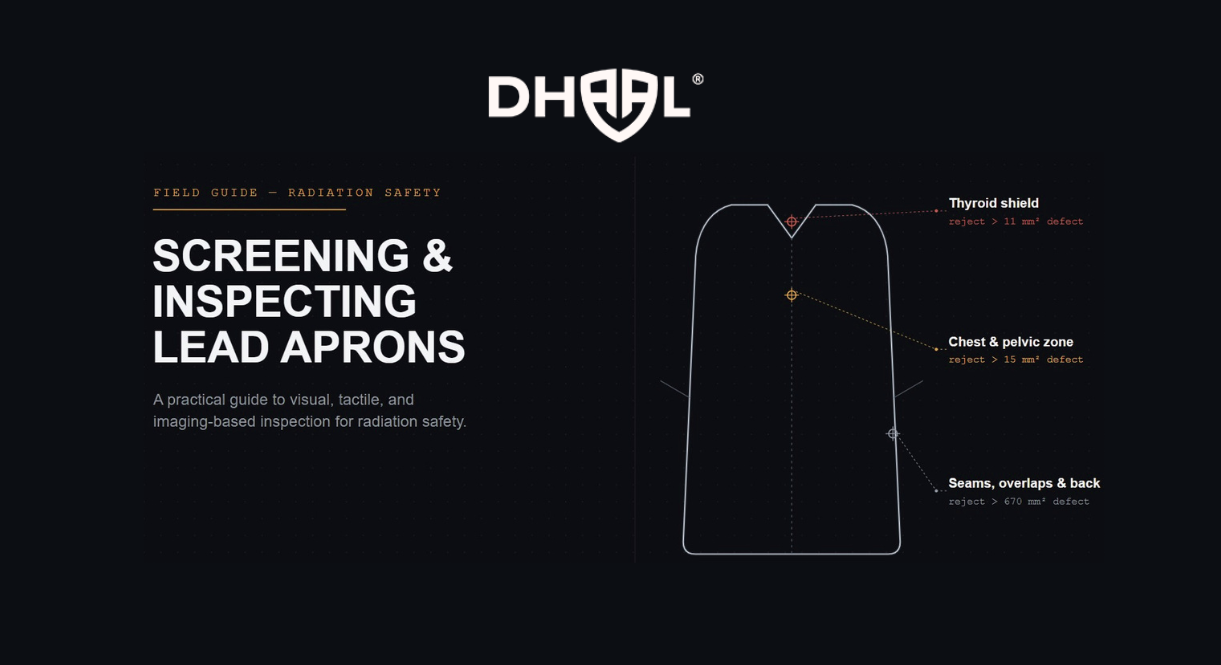
- A defect larger than 15 mm² appears over an area that shields a critical organ (chest or pelvic region).
- A defect larger than 670 mm² appears along a seam, in an overlapped section, or on the back of the apron.
- A thyroid shield has any defect larger than 11 mm².
These thresholds reflect the outsized importance of shielding integrity directly over sensitive organs versus less critical areas of coverage.
Building This Into Your Program
A few practical takeaways for keeping a lead apron program audit-ready:
- Maintain an inventory. Every apron and thyroid shield should be tagged or numbered so its inspection history can be tracked individually.
- Schedule annual inspections as a recurring task, not an ad hoc one.
- Document everything — date, inspector, findings, and disposition (pass, monitor, or retire).
- Retire and dispose of failed aprons promptly rather than leaving them in circulation “just in case.”
- Train staff who handle aprons daily (storing them on hangers rather than folded, for instance) since improper storage is one of the leading causes of premature cracking.
The Bottom Line
Lead aprons feel like simple, static equipment, but they’re a critical control in any radiation safety program — and like any control, they need to be verified, not assumed. A consistent annual inspection routine, backed by imaging screening when something looks off, keeps staff protection reliable and keeps your program aligned with accreditation expectations.
Note – This post draws on lead apron inspection guidance published by Stanford Environmental Health & Safety. Facilities should confirm specific thresholds and procedures against their own institutional radiation safety policies, as requirements can vary by organization and jurisdiction.