Radiology has transformed modern medicine, enabling clinicians to diagnose and monitor conditions with remarkable precision. However, imaging procedures such as X-rays, CT scans, and fluoroscopy use ionizing radiation, which carries potential risks with repeated exposure. This is why protective equipment—especially lead aprons—is essential in radiology settings. One of the most critical factors determining their effectiveness is lead equivalent thickness.
Why Lead Aprons Matter
Lead aprons shield the body from scattered radiation. While individual diagnostic doses are usually low, cumulative occupational exposure can pose health risks for radiologists, technicians, and OT staff. Aprons significantly reduce radiation reaching vital organs.
Understanding “Lead Equivalent Thickness”
Lead equivalent thickness expresses how much shielding an apron provides, measured in millimetres (mm) of lead equivalence. Modern aprons may be lead-free or composite, but are tested to provide protection equivalent to a specified thickness of lead.
Standard Thickness Levels
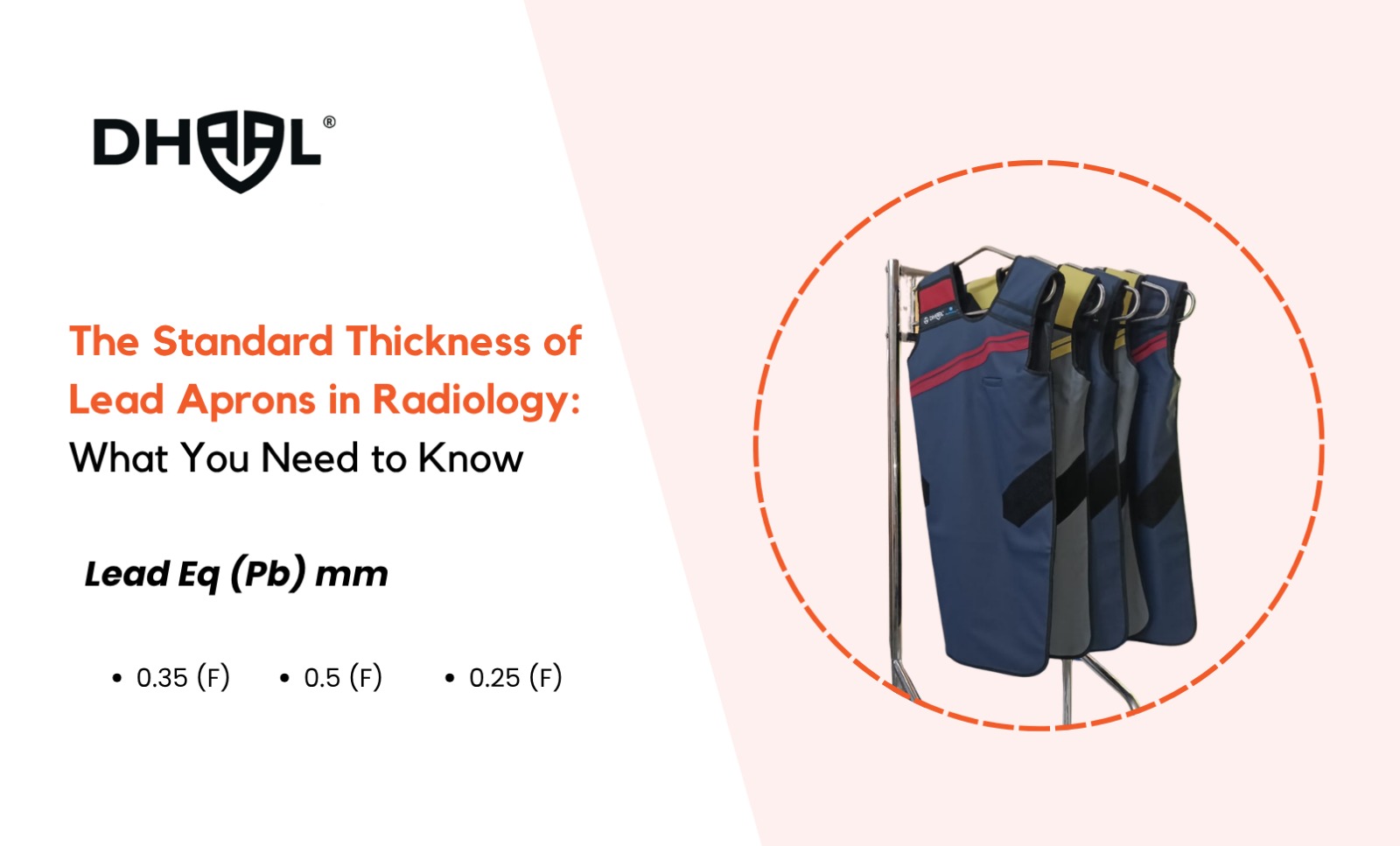
1) 0.25 mm Lead Equivalent
- Basic protection level
- Lightweight and comfortable for short procedures
- Suitable for patients and low-exposure X-ray settings
- ~90–95% attenuation (energy-dependent)
2) 0.35 mm Lead Equivalent
- Moderate protection option
- Common in diagnostic X-ray environments
- Good balance between comfort and safety
3) 0.5 mm Lead Equivalent (Occupational Standard)
- Preferred for staff in interventional radiology, fluoroscopy, and OTs
- ~95–99% attenuation of scattered radiation
- Better suited for long or repeated exposure
AERB Recommendation for X-ray Use
The Atomic Energy Regulatory Board (AERB) recommends 0.25–0.35 mm lead equivalence for routine diagnostic X-ray usage, where exposure levels are controlled and generally low.
However, it is important to understand:
- Apron thickness alone does not define protection.
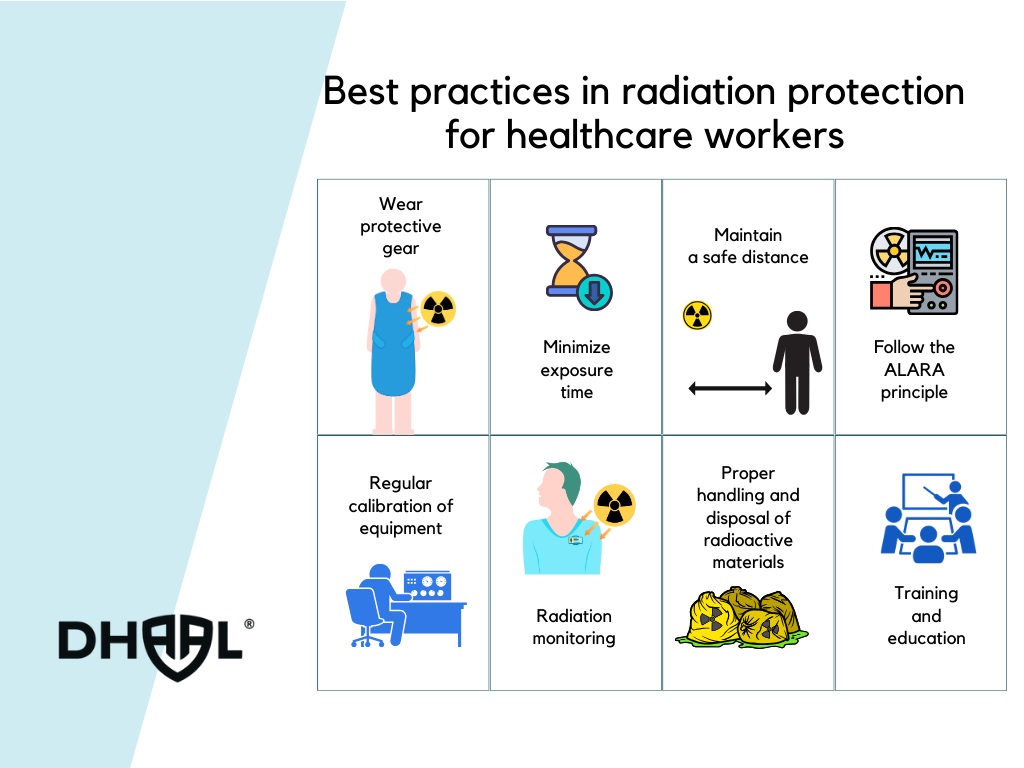
- Radiation safety also depends on distance from source, exposure time, and dose levels (time–distance–shielding principle).
- In higher exposure scenarios (e.g., fluoroscopy, interventional procedures), 0.5 mm lead equivalent is advisable for occupational safety.
What Determines the Right Thickness?
Selecting the appropriate apron depends on:
- Type of procedure – Fluoroscopy/interventional work requires higher shielding
- Exposure duration – Longer procedures need more protection
- Distance from source – Greater distance reduces exposure significantly
- User role – Staff need more protection than patients
- Comfort & ergonomics – Weight distribution affects fatigue
- Regulatory context – Follow AERB guidance for X-ray; use higher equivalence for high-dose settings
Modern Innovations
Many aprons now use lead-free or composite materials that are lighter and environmentally safer while maintaining certified lead equivalence.
Maintenance and Safety Checks
Regardless of thickness:
- Inspect regularly for cracks or damage
- Store by hanging (never fold)
- Perform periodic radiation integrity testing
Conclusion
For routine diagnostic X-ray environments, 0.25–0.35 mm lead equivalence (as recommended by AERB) is generally adequate. For staff involved in fluoroscopy, interventional radiology, or prolonged exposure, 0.5 mm lead equivalent offers superior occupational protection.
Effective radiation safety is not just about lead apron thickness—it’s about combining proper shielding, safe distance, and controlled exposure time to protect the professionals who protect others.